Search & Filters
Area, price, bedrooms, yearly rent and title documents, with saved searches.
Property Apps Built for Nigeria
DPX handles real estate app development in Nigeria: property listing apps, property investment and crowdfunding apps, estate and facility management apps, and apps for estate agents, on Android and iOS. We built PropCrowdy, a property investment app live on Google Play. Android apps start from ₦1,300,000, with the code and store accounts in your name.
Real estate apps from DPX start at ₦1,300,000 for Android and ₦1,500,000 for iOS. Features are priced on top: maps and location from ₦250,000, chat between buyers and agents from ₦350,000, payments from ₦300,000 and an admin dashboard from ₦400,000. Most projects take 6 to 12 weeks, every quote is itemised, and the code and store accounts are in your name.
Area, price, bedrooms, yearly rent and title documents, with saved searches.
Every listing pinned on the map, with nearby properties to compare.
Fund a wallet, invest in projects and follow a portfolio, as in PropCrowdy.
Service charges and levies paid through Paystack or Flutterwave.
Maintenance requests with photos, and access codes for visitors.
Listings, leads and inspection bookings managed from the phone.
We map your buyers, tenants, agents or investors and agree an itemised scope and price.
User flows, wireframes and a clickable prototype approved before development starts.
App, server and admin dashboard demonstrated at each milestone so you can steer.
Google Play and App Store submission handled, with maintenance offered after launch.
A listing app lives or dies on how quickly someone can find a property worth inspecting. We build search and filters for the things Nigerian buyers and renters actually ask about: area, price, number of bedrooms, rent paid yearly, serviced or not, and the title documents on offer. Listings carry photos, video and a pin on the map, and users can save favourites and get a push notification when something new matches their search. Enquiries go to the right agent through in-app chat or a call button, and your team approves listings from an admin dashboard so stale or fake ones come down quickly. Images are compressed for mid-range Android phones and patchy networks, so pages still load on the move.
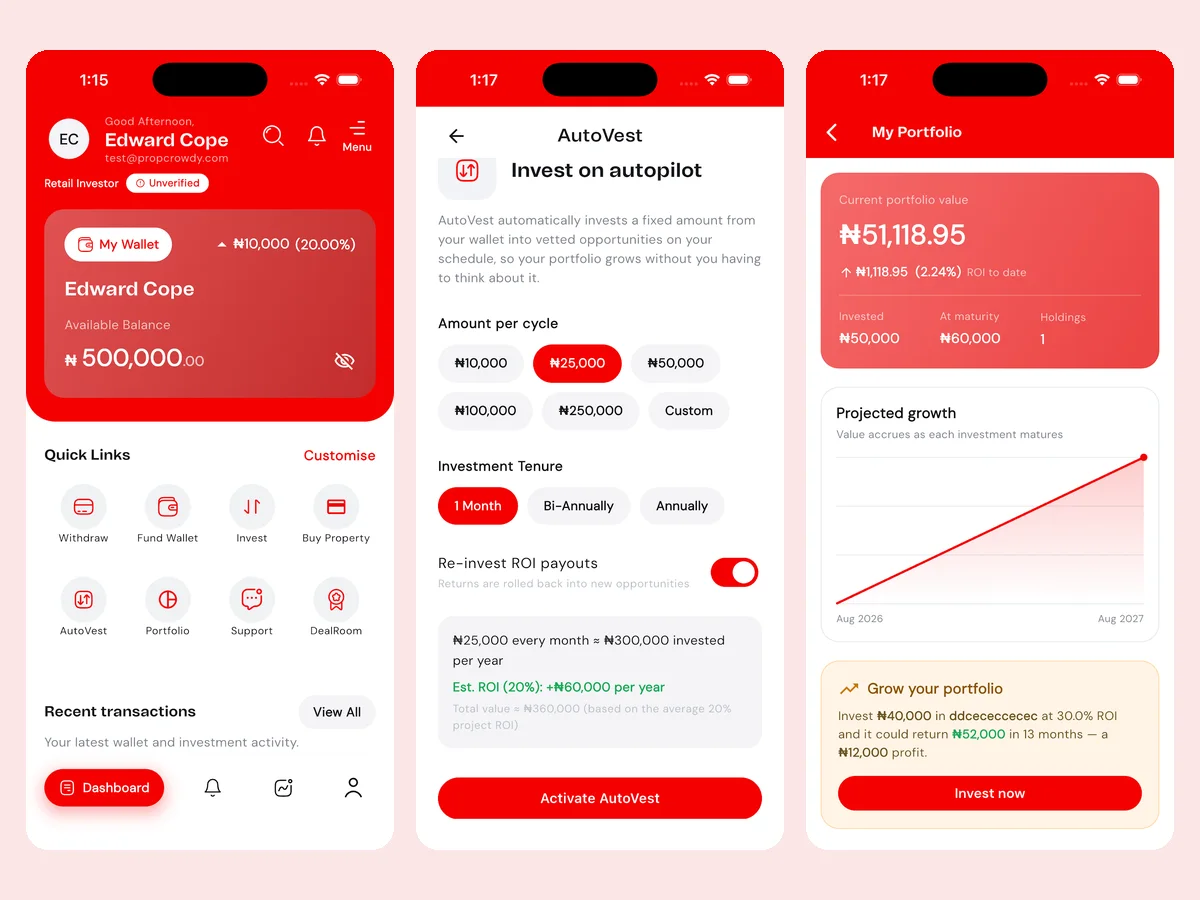
This is the kind of real estate app development in Nigeria we have shipped and published. PropCrowdy, live on Google Play, lets users fund a wallet, invest in vetted property developments, set up AutoVest for automatic recurring investing, and follow their portfolio and its projected growth. An investment app needs more care than a listing app: user accounts with identity checks, Paystack or Flutterwave payments confirmed on the server, clear records of every unit bought, and an admin side where your team publishes projects and posts updates. Investment products are regulated, so arranging any licence, registration or licensed partner is your responsibility; DPX builds the product and designs it around the rules your advisers set.
For estates, apartment blocks and managed properties, an app replaces the WhatsApp group and the paper notice board. Residents pay service charges and levies through Paystack or Flutterwave and see what they owe. They log maintenance requests with a photo, and follow the request until it is closed. They generate access codes for visitors, so the gate knows who to expect, and receive notices from the estate manager by push notification. The facility manager gets an admin dashboard showing payments received, open requests, contractors assigned and residents by unit. The same build can serve a single estate or a property management company running several, with each estate’s residents and records kept separate.
Agents work from their phones, so an agent app puts the day’s work in one place: adding a listing with photos and location from the property itself, receiving enquiries from the listing app, logging each lead and following it up, and booking inspections in a calendar with reminders for both sides. Agency owners see listings, leads and inspections across the whole team from the admin dashboard. Offline mode, from ₦200,000, lets an agent fill in a listing at a site with no signal and send it when the connection returns. The agent app and the customer app usually share one back end, which keeps the cost down and every listing in step across both.
Android apps start at ₦1,300,000 and iOS apps at ₦1,500,000, and the features you add are priced individually: user accounts from ₦200,000, push notifications from ₦150,000, payments from ₦300,000, chat from ₦350,000, maps and location from ₦250,000 and an admin dashboard from ₦400,000. Every quote is itemised, so you can see what each part costs and launch with what matters first. Design is included, with a clickable prototype approved before development. Most projects take 6 to 12 weeks. We publish to Google Play and the App Store under your own developer accounts; the stores charge US$25 once and US$99 a year respectively. You own the source code, servers and databases, and maintenance is offered after launch.
Client perspectives
Since our new store launched, sales have increased by 50%. The checkout experience is seamless and our customers love it.
Android apps start at ₦1,300,000 and iOS apps at ₦1,500,000. Features such as maps, chat, payments and an admin dashboard are priced individually, and every quote is itemised.
Yes. PropCrowdy, a real estate investment app with a wallet, vetted property developments, AutoVest recurring investing and portfolio tracking, is live on Google Play.
Yes. Service charges and levies can be paid through Paystack or Flutterwave, with each payment recorded against the resident’s unit on the admin dashboard.
Investment products are regulated, and arranging any licence, registration or licensed partner is your responsibility. DPX builds the product around the requirements your advisers set.
Most projects take 6 to 12 weeks, depending on scope. You get the timeline in writing with the quote.
You do. The source code, store accounts, servers and databases are in your name, and the app is published under your own developer accounts.